Tyre Size Guide: How to Read Sidewall Markings and Pick the Right Tyres
A note on brand rankings: "Best" tyre picks below are drawn from independent testing (notably Consumer Reports' 2026 tyre ratings) and reflect general category leaders. Actual availability and pricing vary significantly by country — always confirm what's sold and serviced in your market before buying.
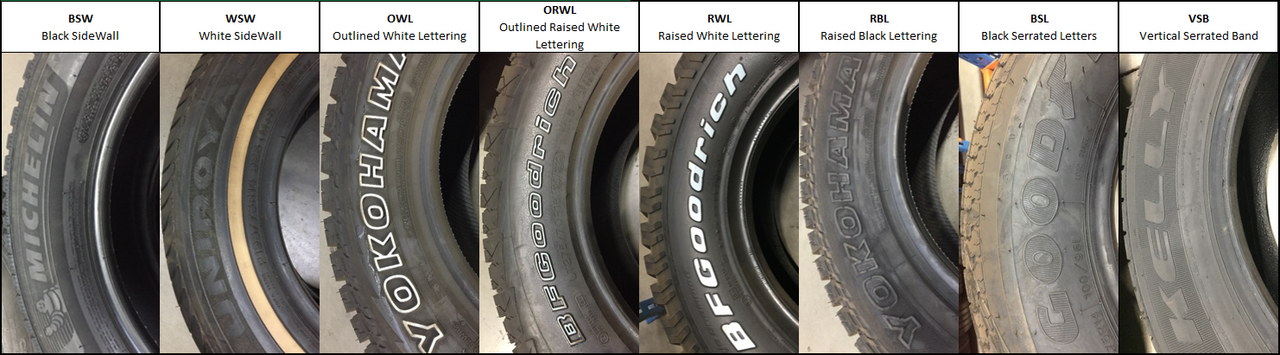 Image: Wikimedia Commons — CC BY-SA 4.0
Every tyre on sale carries a code stamped into its sidewall that looks like gibberish until you know how to read it — something like 225/40 R18 94Y. That string tells you the tyre's width, profile, construction, wheel-fit, and exactly how much weight and speed it's rated to handle. Get any part of it wrong when replacing a tyre, and you can affect everything from fuel efficiency to how your car handles in an emergency stop.
Breaking down the code: 225/40 R18 94Y
| Part of the code | What it means |
|---|---|
| 225 | Tyre width in millimetres, measured sidewall to sidewall |
| 40 | Aspect ratio — the sidewall's height as a percentage of the width (here, 40% of 225mm) |
| R | Radial construction — the standard for virtually all modern tyres |
| 18 | Rim diameter in inches — this must exactly match your wheel |
| 94 | Load index — a code representing the maximum weight the tyre can carry (see table below) |
| Y | Speed rating — a letter representing the tyre's maximum sustained speed |
A lower aspect ratio (say, 35 instead of 55) means a shorter, stiffer sidewall — common on sportier cars for sharper handling, at some cost to ride comfort over potholes. A higher aspect ratio gives a taller, more cushioned sidewall that absorbs bumps better, which is why it's more common on family cars and SUVs.
Load index: what those two digits actually mean
The load index isn't the weight itself — it's a code that maps to a weight in a standardized chart. A few common reference points:
| Load index | Max load per tyre |
|---|---|
| 82 | ~475 kg |
| 91 | ~615 kg |
| 94 | ~670 kg |
| 100 | ~800 kg |
| 109 | ~1,030 kg |
Multiply the per-tyre figure by four for a rough idea of total capacity, though manufacturers build in a safety margin so it's never a straight one-to-one with your car's actual weight. Some tyres carry an "XL" or "Extra Load" marking, meaning they're reinforced to handle a higher load than a standard tyre of the same size.
Speed ratings, decoded
| Letter | Max speed | Typical use |
|---|---|---|
| S | 180 km/h | Family sedans, hatchbacks |
| T | 190 km/h | Compact and mid-size cars |
| H | 210 km/h | Sportier sedans and SUVs |
| V | 240 km/h | Performance-oriented cars |
| W | 270 km/h | High-performance sports cars |
| Y | 300 km/h | Supercars and top-tier performance EVs |
The golden rule: never fit a tyre with a lower load index or speed rating than what your car originally came with — check your owner's manual or the sticker inside the driver's door for your car's exact specification.
Tyre categories: which type actually fits how you drive
The default choice for most drivers in moderate climates — a balanced compromise across dry, wet, and light winter conditions. Not ideal for extreme heat or genuine snow, but the lowest-hassle option for year-round use.
Optimized for warm, dry-to-wet conditions with a softer rubber compound for maximum grip — but that same soft compound hardens and loses grip sharply once temperatures drop, so these shouldn't be used through a cold winter.
A harder tread pattern with deep grooves and a rubber compound that stays flexible in freezing temperatures, dramatically improving grip on snow and ice. Essential in regions with real winters; unnecessary in most of India.
Built for maximum cornering grip and steering response, usually paired with a lower-profile sidewall — the tradeoff is a firmer ride and typically a shorter tread life than a comfort-oriented tyre.
Which brands actually test well
Independent testing bodies like Consumer Reports run standardized wet-braking, dry-handling, hydroplaning-resistance, and treadwear tests across dozens of tyres every year. Some consistent 2026 category leaders worth knowing, even if not all are sold in every market:
- All-season: Michelin's Defender2 and CrossClimate2 range have consistently topped independent all-season rankings for balanced wet/dry performance and long tread life.
- Winter: Nokian's Hakkapeliitta R5 is a repeat winter-category leader in cold-climate markets.
- Performance: Continental's ExtremeContact Sport 02 has scored strongly for dry grip and braking in performance-tyre comparisons.
- Budget-conscious all-season: Bridgestone's Turanza All Season 6 and Pirelli's Cinturato All Season SF3 both score well without commanding flagship pricing.
Beyond these, brands like Goodyear, Hankook, Yokohama, Kumho, Toyo, and Apollo (a major India-focused manufacturer) all have well-regarded tyres within specific size and vehicle categories — the "best" tyre is really the best-tested tyre in your exact size, vehicle type, and climate, not a single universal winner.
The practical takeaway
Find your current tyre's full code on the sidewall before shopping, match the size and load/speed rating exactly (or go up, never down), pick the category that matches your actual climate and driving style, and cross-check independent test results for your shortlisted size rather than relying on brand reputation alone. A ₹2,000 difference between two tyres of the same size is often the difference between mediocre and genuinely class-leading wet-weather braking distance.
Sources: Consumer Reports tyre testing (2026), tyre industry standard sizing references. Image: Wikimedia Commons (CC BY-SA 4.0).