BYD Sealion 7: Features, Variants, and Price in India
A note on figures: The Sealion 7 is not among BYD's fully homologated India models, and pricing has changed several times since its February 2025 launch, including a new entry variant added in August 2026. The figures below reflect the most recently reported ex-showroom range as of this article's last verified date — confirm current pricing with a dealer before booking.
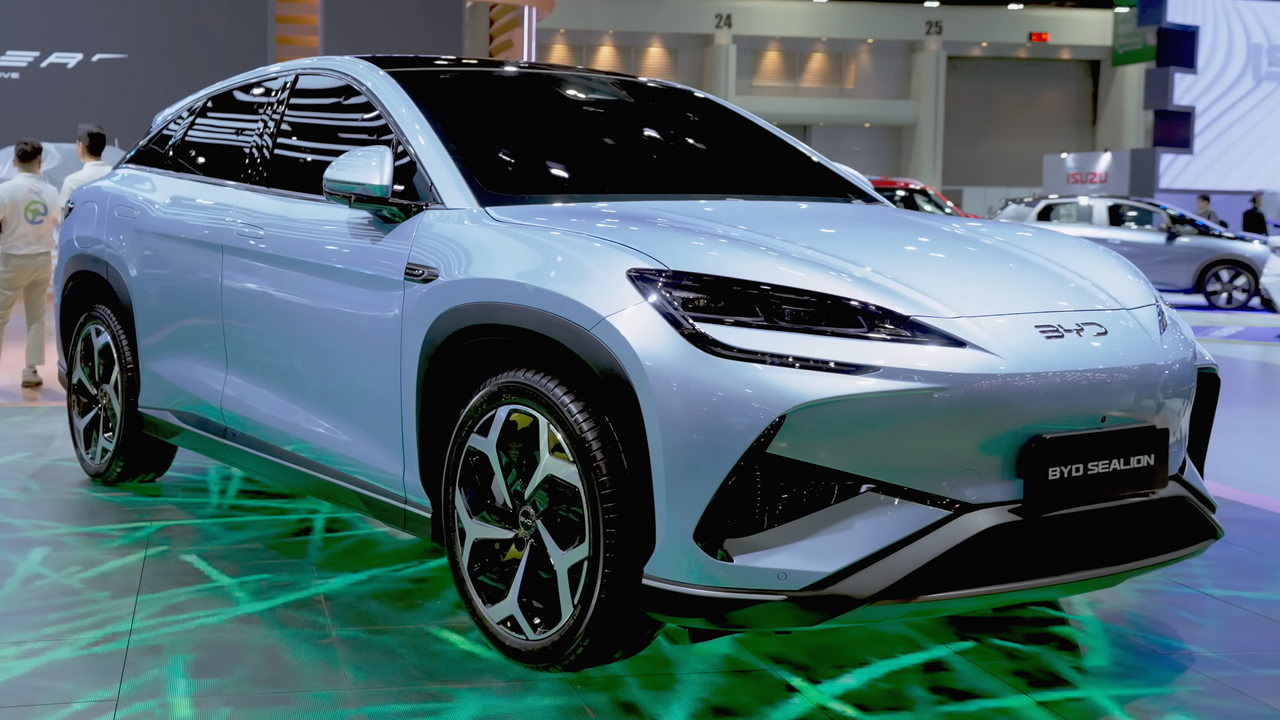 Photo: Wikimedia Commons — CC BY 3.0
The Sealion 7 is BYD's newest and most expensive play in India — a 5-seater SUV-coupe built on the same underlying platform as the Seal sedan, but repackaged into a larger, more family-oriented body. Launched in February 2025, it's since had its lineup restructured twice: once to add a commemorative anniversary edition, and again in August 2026 to introduce a genuinely cheaper entry point.
A coupe-SUV built for families, not just looks
At 4,830mm long with a 2,930mm wheelbase, the Sealion 7 has genuine interior presence — cabin space usually associated with much pricier luxury EVs, according to reviewers. Despite the sloping coupe roofline, BYD has kept practicality intact: a 500-litre boot plus a 58-litre front frunk, and a 170mm ground clearance that's meaningfully higher than the Seal sedan's 145mm, making it noticeably more confidence-inspiring on rougher Indian roads.
The August 2026 shakeup: a genuinely cheaper way in
The new Dynamic trim isn't just a stripped-down Premium — it runs a smaller 71.8 kWh battery specifically to hit a lower price point, sitting ₹8 lakh below the variant it replaced as the entry model.
For over a year, the Sealion 7 was sold only in Premium and Performance trims starting around ₹48.90-49.90 lakh. That changed in August 2026, when BYD introduced an entry-level Dynamic trim at ₹41.90 lakh — a genuinely different, smaller 71.8 kWh battery pack (down from 82.56 kWh) delivering a still-respectable 520 km claimed range, positioned specifically to widen the Sealion 7's addressable buyer base below the ₹50 lakh mark.
Variant by variant
The newest, most affordable way into a Sealion 7 — a smaller 71.8 kWh battery for a 520 km claimed range, replacing Premium as the base trim at ₹8 lakh less.
Single rear motor, 230 kW / 308 bhp, the full 82.56 kWh battery for the range-topping 567 km claimed figure, and a 6.7-second 0-100 km/h time.
Dual-motor AWD, 390 kW / 523 bhp combined, and a genuinely quick 4.5-second 0-100 km/h time — while still managing a strong 542 km claimed range despite the extra motor and AWD hardware.
Safety and cabin tech
| Spec | Figure |
|---|---|
| Seating capacity | 5 seats |
| NCAP rating | 5-star, Euro NCAP (2025) |
| Standard airbags | 11 |
| Boot space | 500 litres + 58-litre frunk |
| Ground clearance | 170mm |
| Infotainment | 15.6-inch rotating touchscreen, 10.25-inch driver display |
The Sealion 7 carries 11 airbags as standard across every trim — a genuinely strong figure for the segment — alongside a panoramic sunroof, powered and ventilated front seats, a 360-degree camera, hill hold control, and a full Level 2 ADAS suite. BYD's proprietary iTAC (Intelligent Torque Adaptation Control) and Cell-to-Body construction, where the 82.56 kWh battery pack is integrated directly into the chassis, underpin the higher-battery variants.
The honest tradeoffs
Reviewers consistently praise the cabin quality — "impeccable interior quality for the price," as one CarDekho review put it — and the coupe-SUV styling that "looks much more expensive than it actually is." The real-world criticism centres on the ADAS calibration: several reviews note the adaptive cruise control and automatic emergency braking can be oversensitive for Indian traffic conditions, braking earlier than expected in ways that can catch following drivers off guard. Charging infrastructure is also a practical caution — most residential setups in India cap out at 4-5kW, meaning a genuinely useful home charge can take well over 14 hours despite the car's fast-charging capability.
Who it competes with
Autocar India lists the Sealion 7's rivals as spanning an unusually wide net — from the Volvo EX40 to, somewhat surprisingly, the Toyota Fortuner and Hilux, reflecting how it competes as much on size and presence as on powertrain type. Within the EV-specific segment, it sits closest to the Hyundai Ioniq 5, Kia EV6, and its own sibling from the same platform, the Seal — with the Sealion 7's higher ground clearance and larger cabin being the clearest reasons to choose it over the sedan.
Sources: Autocar India, Autocar Professional, CarLelo, CarWale, CarDekho, ZigWheels, Cars24, Team-BHP, Wikipedia — figures current as of September 2026 and subject to change; confirm with a dealer before purchase. Image: Wikimedia Commons (CC BY 3.0).