How Car Engines Work: Types of Engines Explained
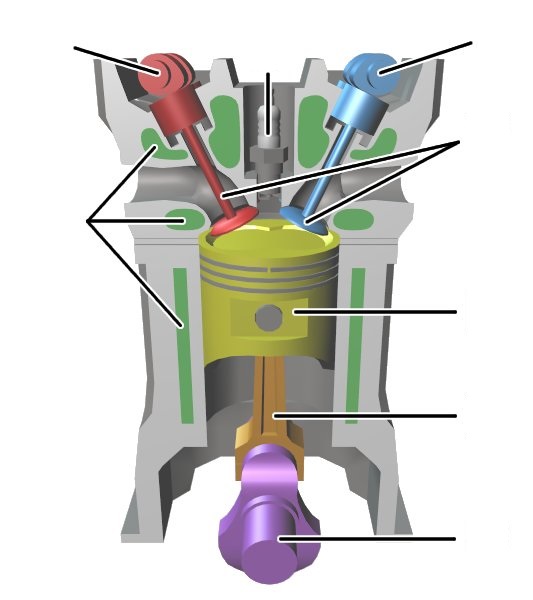 Image: Wikimedia Commons — CC BY-SA 4.0
Pop the hood of almost any petrol or diesel car on the road and, underneath the covers and wiring, you'll find some version of the same basic machine: a sealed metal block where tiny, controlled explosions push pistons up and down thousands of times a minute, and that motion gets converted into the spinning force that turns your wheels. Everything else — turbochargers, fuel injection, engine layouts — is a variation on that one core idea.
This guide breaks down the four-stroke cycle every conventional engine runs on, the major engine layouts you'll actually encounter (inline, V, flat, and rotary), and the real difference between a petrol and a diesel engine.
The four-stroke cycle: the heart of almost every engine
Nearly every petrol or diesel car engine on sale today runs on the four-stroke cycle, first codified by German engineer Nikolaus Otto in 1876 (which is why it's sometimes called the "Otto cycle"). A "stroke" is one full movement of a piston up or down inside its cylinder. Here's what happens in each of the four:
The piston moves down, an intake valve opens, and a mixture of air and fuel (or just air, in a diesel) gets drawn into the cylinder.
Both valves close, and the piston moves back up, squeezing that air-fuel mixture into a much smaller space — which heats it up and primes it for ignition.
In a petrol engine, a spark plug ignites the compressed mixture; in a diesel, the compression alone is enough to ignite the fuel. The resulting explosion forces the piston back down hard — this is the stroke that actually generates usable power.
The piston moves back up one last time, an exhaust valve opens, and the spent gases are pushed out toward the exhaust system — clearing the cylinder to start the cycle again.
A crankshaft, connected to every piston, converts this repeated up-and-down motion into the rotational spinning force that ultimately reaches your wheels through the transmission. A four-cylinder engine simply staggers this cycle across four cylinders so that at any given moment, one is always on its power stroke — which is why more cylinders generally means smoother, more consistent power delivery.
Petrol vs diesel: it's about how combustion starts
The core difference isn't the fuel itself — it's whether ignition is triggered by a spark or by compression alone.
Petrol (gasoline) engines use spark ignition: a spark plug fires at a precise moment to ignite the compressed air-fuel mixture. Diesel engines use compression ignition: they compress air far more tightly (a diesel's compression ratio is typically well above a petrol engine's), which raises its temperature enough that injected diesel fuel ignites on its own, with no spark plug needed.
This is also why diesel engines tend to produce more torque at lower RPM — useful for towing and hauling — while petrol engines typically rev higher and produce peak power further up the rev range. Diesels also tend to be more fuel-efficient per litre burned, though stricter emissions norms have narrowed that advantage in many markets, including India, in recent years.
Engine layouts: inline, V, flat, and rotary
Beyond how combustion is triggered, engines also differ in how their cylinders are physically arranged. This matters for smoothness, size, packaging, and — for enthusiasts — sound.
| Layout | How cylinders sit | Where you'll see it |
|---|---|---|
| Inline (straight) | All cylinders in a single row | Most mainstream hatchbacks and sedans — inline-3 and inline-4 are the most common configurations on sale today |
| V-configuration | Two banks of cylinders angled into a "V" sharing one crankshaft | Larger, more powerful engines (V6, V8) in performance and luxury cars, where an inline layout would be too long to fit |
| Flat (boxer) | Two banks of cylinders lying horizontally opposite each other | Subaru and Porsche — prized for a low centre of gravity that improves handling |
| Rotary (Wankel) | A triangular rotor spins inside an oval housing instead of using pistons at all | Historically Mazda (RX-7, RX-8) — compact and smooth, but rare today due to emissions and efficiency challenges |
The inline-4 is by far the most common engine layout in the world, powering the vast majority of mass-market cars sold in India and globally — it's compact, simple to manufacture, and cheap to maintain. Inline-3 engines have become increasingly common in smaller hatchbacks and compact SUVs as manufacturers look to save weight and improve fuel efficiency, at a small cost to refinement.
What about turbochargers?
A turbocharger isn't a different type of engine — it's an add-on that makes any of the layouts above produce more power without needing extra cylinders. It uses the engine's own exhaust gases to spin a turbine, which forces more compressed air into the cylinders than they'd draw in naturally. More air means more fuel can be burned per cycle, which means more power from the same engine size — which is exactly why so many modern engines have downsized (a 1.0-litre turbo-petrol replacing what used to be a naturally-aspirated 1.5-litre or 1.6-litre) while matching or beating the older engine's output.
Where electric motors fit in
None of the above applies to a pure electric vehicle. EVs use an electric motor, not an internal combustion engine — there's no combustion, no pistons, no crankshaft, and no multi-stroke cycle at all. A motor spins directly using electromagnetic force, which is also why EVs deliver maximum torque instantly from a standstill rather than needing to build up through a rev range. Hybrids sit in between, pairing a smaller combustion engine (usually a conventional inline layout) with an electric motor to share the workload.
Sources: general automotive engineering references, manufacturer technical documentation. Image: Wikimedia Commons (CC BY-SA 4.0).